



Bilanz der Berlinale 2026 – die wichtigsten Preise
Von Holger Jacobs

23.02.2026
Viele gute Filme, würdige Gewinner und Gewinnerinnen und ein Skandal
Keine Berlinale ohne einen Skandal.
Denn es sind die Schicksale der Menschen in den Kriegsgebieten, die die Filmschaffenden bewegt.
Über den Ukraine-Krieg war dieses Mal auf der Berlinale nichts zu sehen.
Obwohl sich der Überfall Russlands auf die Ukraine heute zum 4. Mal jährt.
Dafür aber der Gaza-Krieg, der in den beiden Filmen „Chronicles of the Siege“ (Chroniken der Belagerung) und „Where to go?“ zu finden war.
In „Chronicles oft the Siege” von ABDALLAH ALKHATIB geht es um die erdrückende Situation von Menschen, die in einer fiktiven Stadt unter Belagerung stehen. Während sie ständig von Scharfschützen beschossen werden, flüchtet sich eine Gruppe von Filmliebhabern in eine Videothek.
Doch Hunger und Kälte setzt ihnen zu und schließlich überlegen sie, ob sie nicht ihre geliebten Video-Kassetten verfeuern sollten, um nicht erfrieren zu müssen…

Filmcrew „Chronicles of the Siege“, ph: Holger Jacobs
Der syrisch-palästinensische Regisseur ABDALLAH ALKHATIB bekam für seinen Film „Chronicles oft he Siege“, der in der Sektion Perspectives lief, den GWFF (Gesellschaft zur Wahrnehmung von Film- und Fernsehrechten) Preis für das beste Spielfilmdebüt.
Bei der Abschlussfeier präsentierte er sich und seine Crew auf dem Roten Teppich mit einer riesigen Palästinenser-Flagge und bei der Preisübergabe im Saal wenig später erklärte er in seiner Dankesrede, dass Deutschland der Partner des Völkermordes in Gaza wäre, worauf Umweltminister Carsten Schneider (war als einziger aus dem Bundeskabinett gekommen) demonstrativ den Saal verließ.
Für einen Eklat gleich am Anfang der Berlinale hatte ausgerechnet auch Jury-Präsident WIM WENDERS gesorgt, als er in einem Interview verkündete: „Wir müssen uns aus der Politik heraushalten“, obwohl die Berlinale eigentlich explizit als ein politisches Filmfestival gilt.

Wim Wenders, Jury-President, ph: Holger Jacobs
Aber, wenn man die Filme von Wenders kennt, weiß man, dass für ihn mehr das Visuelle und Poetische zählt und nicht die Politik.
Bilanz des Festivals
Insgesamt fällt die Bilanz dieser Berlinale Ausgabe sehr positiv aus.
Viele tolle Filme (ich konnte leider nur einen Bruchteil sehen, hörte aber von Kollegen nur Gutes), viele herausragende Schauspielleistungen und viele Filmentdeckungen.
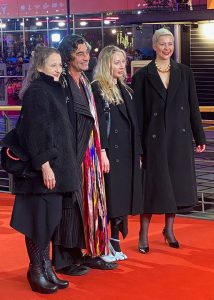
Belarus-Dissident Maria Kolesnikowa (right) with Sasha Waltz (left) and Jochen Sandig, ph: Holger Jacobs
Goldener Bär für den besten Film
Großes Lob geht an den türkisch-stämmigen Regisseur ILKER CATAK für seinen Film „Gelbe Briefe“, für den er den Golden Bären überreicht bekam.
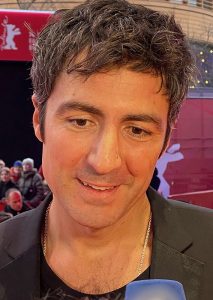
Ilker Catak, Golden Bear for „Yellow Letters“, ph: Holger Jacobs
Es ist das erste Mal seit 20 Jahren, dass wieder eine deutsche Produktion einen Goldenen Bären bekam.
Bemerkenswert ist, dass es auch schon vor 20 Jahren mit „Gegen die Wand“ ein türkisch-stämmiger Regisseur aus Hamburg war, der geehrt wurde:
FATIH AKIN.
Der Film „Gelbe Briefe“ handelt von einem Künstlerehepaar, welches in der Türkei regime-kritische Theaterstücke aufführt und dafür vom Staat Berufsverbot bekommt – mittels gelber Briefe.
Wie die beiden mit diesem Schicksalsschlag umgehen ist der Inhalt des Films.
Silberne Bären für Schauspiel
Auch mit dem Silbernen Bären für die beste schauspielerische Leistung in einer Hauptrolle an SANDRA HÜLLER für ihre Rolle in „Rose“ gewann eine Deutsche.
Eine mehr als würdige Preisträgerin.
Der Film spielt zu Zeiten des 30-jährigen Krieges, bei dem bekanntermaßen ein Drittel der Europäischen Bevölkerung durch Verwundung, Krankheit und Seuchen dahingerafft wurde.
Eines Tages taucht ein durch tiefe Narben gekennzeichneter Soldat in einem Dorf auf und behauptet der Erbe eines verlassenen Gutshofs zu sein.
Doch in Wirklichkeit ist der Soldat eine Frau, „Rose“, gespielt von SANDRA HÜLLER.
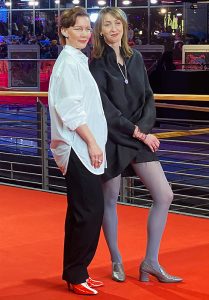
Silver Bear for Sandra Hüller (left, here with Caro Braun), ph: Holger Jacobs
Weitere wichtige Preise gingen an:
Silberne Bären gingen für die beste schauspielerische Leitungen in einer Nebenrolle an ANNA CALDER-MARSHAL und TOM COURTENAY für ihre Rollen in „Queen at Sea“ von LANCE HAMMER über ein Paar, bei welchem einer von ihnen an Demenz erkrankt.
Der Grand Jury Preis ging an den Film „Kurtulus“ (Salvation) von EMIN ALPER über Auseinandersetzungen in einem türkisch-kurdischen Dorf, der Jury-Preis an „Queen at Sea“ von LANCE HAMMER (Filmbeschreibung siehe oben) und der Drehbuch-Preis an GENIÈVE DULUDE de CELLES für „Nina Roza“, verfilmt von ihr selbst.
In „Nina Roza“ geht es um die Geschichte eines Kanadiers, der nach 30 Jahren in sein Heimatland Bulgarien zurückkehrt.
Ein Silberner Bär für die beste Regie ging an den britischen Filmregisseur GRANT GEE für seinen Film „Everybody Digs Bill Evans“, in dem in Form einer Filmbiographie das dramatische Leben des Jazzpianisten BILL EVANS Anfang der 60er Jahre in New York nacherzählt wird.
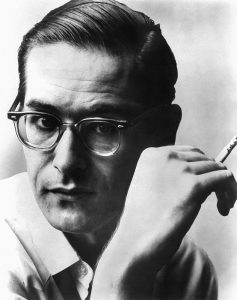
Jazz-Piano BILL EVANS, ph: Steve Shapiro/ Wikimedia
Mein sehr gut besprochener Film „Der Heimatlose“ von KAI STÄNICKE (kultur24 berichtete) wurde mit einem Teddy-Award belohnt.
Eine besondere Erwähnung möchte ich der Initiative des sogenannten Co-Production-Market geben, einer Unterorganisation des EFM Filmmarktes der Berlinale.
Die Initiative umfasst mehrere kleine Preise für junge Filmemacher, die Geld für ihre Projekte sammeln.
Der diesjährige Siegerfilm „Gelbe Briefe“ von Ilker Catak gehörte auch einmal zu den hier geförderten Filmen.
Eines der Preise mit 5000.- Euro dotiert, der „Gen-Z Audience Award“, soll ein Projekt unterstützen, welches sich speziell an das Gen-Z Publikum richtet (Geburtsjahrgänge ab dem Jahr 2000), da diese Altersgruppe immer weniger ins Kino geht.
Für die Jury wurden fünf Studenten aus Filmhochschulen in Deutschland und Frankreich ausgesucht (über das Deutsch-Französische Jungendwerk), die das Filmprojekt „Cura Sana“ von LUCIA ROMERO aus Spanien zum Sieger erwählten.
Auf dem Foto links die Preisträger und rechts die Jurymitglieder PAULINE SZCZESNY, DANIEL BESCHARETI, ISIDORA LAZIC, NICOLAS CHAPT und SOPHIA BEATRICE.

Gen-Z Audience Award, ph: Holger Jacobs
An den letzten beiden Abenden vor der Preisverleihung waren noch einmal zwei Stars aus Hollywood gekommen:
‚AMANDA SEYFRIED für ihren Film „The Testament of Ann Lee“.

Amanda Seyfried, ph: Holger Jacobs
Und CHANNING TATUM (bekannt durch die beiden Striptease-Filme „Magic Mike“) für den Film „Josephine“ im Wettbewerb.

Chenning Tatum and Filmcrew, ph: Holger Jacobs
Damit sind die 76. Internationale Filmfestspiele von Berlin am Sonntag zu Ende gegangen.
Lob an die Intendantin TRICIA TUTTLE für die Auswahl der Filme und auch Lob an die Veranstalter für die Durchführung des Festivals.
Der Skandal am Abschlussabend wird aber wohl ein Nachspiel haben.
Vielleicht kommen nächstes Jahr ein paar große Hollywood-Stars mehr nach Berlin.
Das würde dem Festival noch einen besonderen Kick verleihen.
Denn mir fiel auf, dass an Abenden ohne große Stars fast keine Fans und auch kaum Fotografen und TV-Teams am Roten Teppich standen.
Das ist dann für die Filmcrew, die an diesem Abend Premiere feiert, ziemlich frustrierend.

Empty red carpet, ph: Holger Jacobs
Das Filmfestival in Cannes hat dafür ein gutes Gegenmittel gefunden:
Man lädt für solche Abende bekannte Schauspieler*innen und auch bekannte Models und schillernde Persönlichkeiten aus Mode und Design ein, selbst, wenn sie mit dem eigentlichen Film des Abends gar nichts zu tun haben.
Zum Beispiel tauchte im letzten Jahr an einem Abend beim Filmfestival in Cannes plötzlich ANGELINA JOLIE auf dem Roten Teppich auf, obwohl sie gar keinen Film beim Festival präsentierte (war für eine Schmuckfirma vor Ort).
Aber das Publikum schrie vor Begeisterung!
Video mit ANGELINA JOLIE in Cannes 2925

Angelina Jolie in Cannes 2025, ph: Holger Jacobs
English text
Berlinale 2026 Review – The Most Important Awards
By Holger Jacobs
February 23, 2026
Good movies, worthy winners, and a scandal
No Berlinale is complete without a scandal.
Because it is the fates of people in war zones that move filmmakers.
There was nothing about the war in Ukraine at this year’s Berlinale, even though today marks the fourth anniversary of Russia’s invasion of Ukraine.
However, the Gaza War was featured in the two movies: „Chronicles of the Siege“ and „Where to Go?“
„Chronicles of the Siege“ by Abdullah Alkhatib deals with the oppressive situation of people under siege in a fictional city. While constantly fired upon by snipers, a group of film enthusiasts seeks refuge in a video store.
But hunger and cold are taking their toll, and they eventually consider burning their beloved videotapes to avoid freezing to death…
Syrian-Palestinian director Abdullah Alkhatib received the GWFF (Society for the Protection of Film and Television Rights) award for Best Feature Film Debut for his film „Chronicles of the Siege,“ which was screened in the Perspectives section.
Filmcrew „Chronicles of the Siege“, ph: Holger Jacobs
At the closing ceremony, he and his crew appeared on the red carpet with a giant Palestinian flag, and during the award presentation in the hall shortly afterward, he declared in his acceptance speech that Germany was complicit in the genocide in Gaza, whereupon Environment Minister Carsten Schneider (the only member of the Federal Cabinet present) demonstratively left the hall.
Jury president Wim Wenders caused a stir right at the start of the Berlinale when he announced in an interview:
„We must stay out of politics,“ even though the Berlinale is explicitly considered a political film festival.
Wim Wenders, Jury-President, ph: Holger Jacobs
But anyone familiar with Wenders‘ films knows that for him, the visual and the poetic are more important than politics.
Festival Summary
Overall, this year’s Berlinale was a very positive success.
Many great movies (I was only able to see a fraction, but I heard nothing but good things from colleagues), many outstanding acting performances, and many cinematic discoveries.
Belarus-Dissident Maria Kolesnikowa (right) with Sasha Waltz (left) and Jochen Sandig, ph: Holger Jacobs
Golden Bear for best picture
Great praise goes to the director (with turkish background) ILKER CATAK for his movie „Yellow Letters,“ for which he received the Golden Bear for Best Picture.
Ilker Catak, Golden Bear for „Yellow Letters“, ph: Holger Jacobs
This is the first time in 20 years that a German production has won a Golden Bear.
It is noteworthy that 20 years ago, another German director of Turkish descent was honored with „Gegen die Wand“ (Head-On): Fatih Akin.
The film „Yellow Letters“ tells the story of an artist couple who perform theatre plays critical of the regime in Turkey and are subsequently banned from working by the state – through yellow letters.
How the two handle this tragic fate is the subject of the movie.
Silver Bear for best leading actor
A actress also from Germany won the Silver Bear for Best Actress in a Leading Role, going to SANDRA HÜLLER for her role in „Rose.“
Silver Bear for Sandra Hüller (left, here with Caro Braun), ph: Holger Jacobs
A more than worthy recipient.
The movie is set during the Thirty Years‘ War, in which, as is well known, a third of the European population perished from wounds, disease, and epidemics.
One day, a soldier marked by deep scars appears in a village and claims to be the heir to an abandoned estate.
But in reality, the soldier is a woman, „Rose,“ played by Sandra Hüller.
Other major awards went to:
Silver Bears for Best Supporting Actors and Actress went to Anna Calder-Marshal and Tom Courtenay for their roles in Lance Hammer’s „Queen at Sea“, about a couple where one partner develops dementia.
The Grand Jury Prize went to Emin Alper’s film „Kurtulus“ (Salvation), about conflicts in a Turkish-Kurdish village. The Jury Prize went to Lance Hammer’s „Queen at Sea,“ and the Screenplay Prize went to Geniève Dulude de Celles for „Nina Roza,“ which she also directed.
„Nina Roza“ tells the story of a Canadian who returns to his homeland of Bulgaria after 30 years.
A Silver Bear for Best Director went to British film director GRANT GEE for his movie „Everybody Digs Bill Evans,“ a biopic recounting the dramatic life of jazz pianist Bill Evans in the early 1960s in New York.
Jazz-Piano BILL EVANS, ph: Steve Shapiro/ Wikimedia
My highly acclaimed film „The Homeless“ by Kai Stänicke (as reported by kultur24) was awarded a Teddy Award.
I would like to give special mention to the Co-Production Market initiative, a sub-organization of the Berlinale’s EFM Film Market.
The initiative includes several small prizes for young filmmakers who raise money for their projects.
This year’s winning movie, „Yellow Letters“ by Ilker Catak, was once among the movies supported by this initiative.
One of the prizes, the „Gen-Z Audience Award,“ worth €5,000, is intended to support a project specifically aimed at Gen Z audiences (born from 2000 onwards), as this age group is increasingly less likely to go to the cinema.
The jury consisted of five students from film schools in Germany and France (selected through the Franco-German Youth Office), who chose the film project „Cura Sana“ by Lucia Romero from Spain as the winner.
Gen-Z Audience Award, ph: Holger Jacobs
The photo shows the winners on the left and the jury members PAULINE SZCZESNY, DANIEL BESCHARETI, ISIDORA LAZIC, NICOLAS CHAPT and SOPHIA BEATRICE on the right.
On the last two evenings before the awards ceremony, two Hollywood stars made an appearance:
AMANDA SEYFRIED for her movie „The Testament of Ann Lee.“
Amanda Seyfried, ph: Holger Jacobs
And CHANNING TATUM (known for the two „Magic Mike“ films) for the film „Josephine,“ which was in competition.
Chenning Tatum and Filmcrew, ph: Holger Jacobs
With that, the 76th Berlin International Film Festival came to a close on Sunday.
Great praise to artistic director TRICIA TUTTLE for her selection of movies and great praise to the organizers for putting on the festival.
Perhaps a few more big Hollywood stars should come to Berlin next year.
That would give the festival an extra boost.
Because I noticed that on evenings without big stars, there were hardly any fans, photographers, or TV crews on the red carpet.
That’s quite frustrating for the film crew celebrating a premiere that evening.
Empty red carpet, ph: Holger Jacobs
The Cannes Film Festival has found a good antidote to this.
For such evenings, they invite well-known actors, models, and glamorous personalities from the worlds of fashion and design, even if they have nothing to do with the actual film being shown.
For example, last year at the Cannes Film Festival, Angelina Jolie suddenly appeared on the red carpet one evening, even though she wasn’t presenting a film at the festival (she was there representing a jewelry company).
But the audience roared with excitement!
Video with Angelina Jolie in Cannes 2025
Angelina Jolie in Cannes 2025, ph: Holger Jacobs

Author: Holger Jacobs
Founder & Editorial Director of kultur24.berlin ug.
Founder & Editorial Director of kultur24 TV on Youtube.
Former correspondent for fashion in Paris.
Photographer, writer and videographer.