

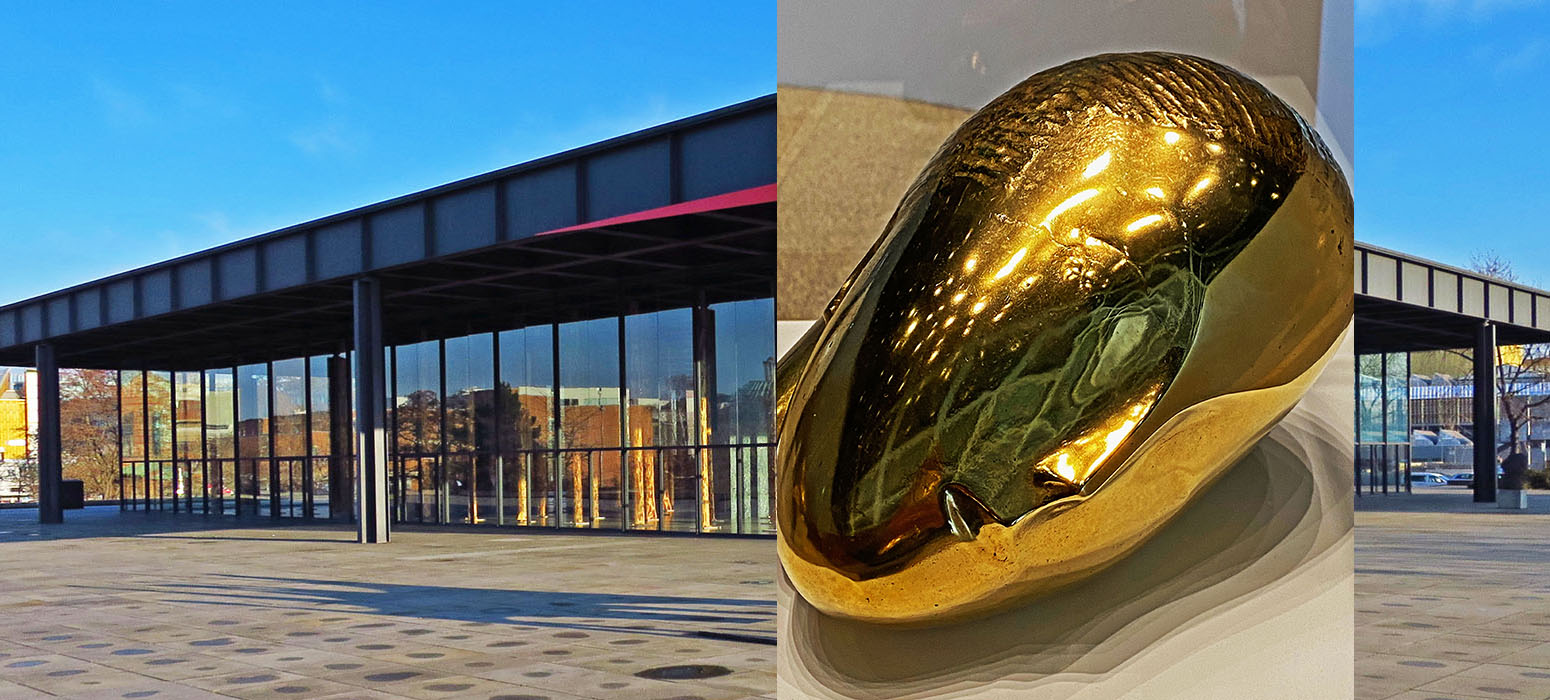
Ausstellung BRANCUSI in der Neuen Nationalgalerie Berlin
Von Holger Jacobs

11.02.2026
Wertung: 🙂 🙂 🙂 🙂 🙂 (fünf von fünf)
Die außergewöhnlichen Skulpturen des Constantin Brancusi
Einer der wichtigsten Bildhauer des 20. Jahrhunderts ist in Deutschland nur wenig bekannt.
Die Gründe dafür kann man nur erahnen.
Vielleicht lag es an den politischen Wirren Anfang bis Mitte des 20. Jahrhunderts in Europa, vielleicht lag es an der Beliebtheit unserer eigenen Bildhauer, wie Wilhelm Lehmbruck oder Georg Kolbe.
Vielleicht lag es auch an dem Verbot moderner Kunst im Dritten Reich.
Vielleicht ist aber auch das Interesse für die Bildhauerei hier bei uns in Deutschland ganz allgemein weniger ausgeprägt, als z.B. in Frankreich.
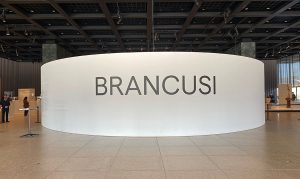
„Brancusi“, Neue Nationalgalerie, Foto: Holger Jacobs
Aus welchen Gründen auch immer der Name BRANCUSI bei uns wenig bekannt ist – jetzt kann einiges nachgeholt werden.
Durch eine große Retrospektive in der Neuen Nationalgalerie mit 150 Werken dieses Ausnahmekünstlers, der die Geschichte der Bildhauerei im 20. Jahrhundert nachhaltig geprägt hat.
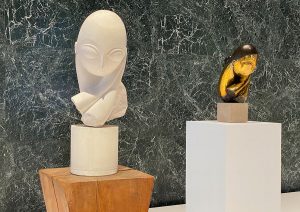
„Brancusi“, Neue Nationalgalerie, Foto: Holger Jacobs
Constantin Brancusi
1876 in Rumänien geboren, kam BRANCUSI nach vielen Reisen, die ihn u.a. nach Wien, Budapest, München und Basel führten, im Jahr 1904 nach Paris, angezogen von den vielen Erzählungen über die reiche Künstlerszene in der französischen Hauptstadt.
Denn Paris war um die Jahrhundertwende das Zentrum der europäischen Kunstszene.
Alle, die als Künstler reüssieren wollten, mussten in die Stadt der Liebe und der Ausschweifungen.
In die Zeit der Belle Epoque.
Von Bildender Kunst, Darstellender Kunst über die Musik, Theater, Oper, Ballett bis zur Bildhauerei– alles und alle trafen sich in Paris und bildeten zusammen einen Melting Pot der Kreativität.
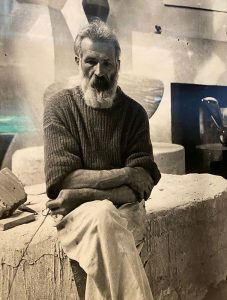
Constantin Brancusi, „Brancusi“, Neue Nationalgalerie, Foto: Holger Jacobs
Zunächst studierte BRANCUSI an der berühmten École Nationale Supérieure des Beaux-Arts am linken Seine-Ufer und konnte bereits 1906 beim Salon d’Automne zwei Arbeiten ausstellen, wo er auch AUGUSTE RODIN traf.
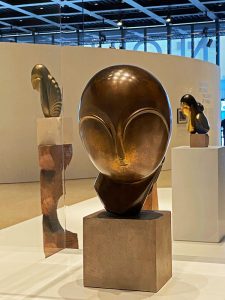
„Brancusi“, Neue Nationalgalerie, Foto: Holger Jacobs
1907 absolvierte BRANCUSI bei RODIN ein einmonatiges Praktikum und machte sich danach selbständig.
Durch rumänische Freunde bekam er erste Aufträge und bezog sein Atelier in der 54, rue du Montparnasse in unmittelbarer Nachbarschaft zu EDWARD STEICHEN.
In dieser Zeit schloss er auch Freundschaften mit anderen Künstlern, wie HENRI MATISSE, MARCEL DUCHAMP, MAN RAY und AMADEO MODIGLIANI.
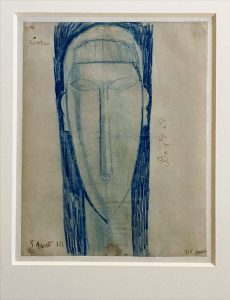
Amadeo Modigliani „Kopf“, 1913, „Brancusi“, Neue Nationalgalerie, Foto: Holger Jacobs
Besonders die Freundschaft mit MODIGLIANI hatte großen Einfluss auf beide.
BRANCUSIS Arbeiten wurden immer schmaler und länger und MODIGLIANIS Portraits in Bild und Skulptur wurden es ebenso.
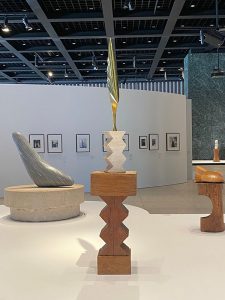
„Brancusi“, Neue Nationalgalerie, Foto: Holger Jacobs
Wichtig wurde in dieser Zeit auch der Kontakt zu dem Kunstsammler PAUL ALEXANDER, der BRANCUSI förderte.
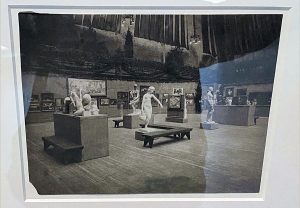
Armory Show, New York, 1913, „Brancusi“, Neue Nationalgalerie, Foto: Holger Jacobs
Ab 1908 entwickelte BRANCUSI eine neue Form der Bildhauerei.
Keine realistischen Darstellungen mehr, wie er es noch bei RODIN erfahren hatte.
Sondern eine Abstrahierung der Realität, die sich in den folgenden Jahren zu Skulpturen entwickelten, die nur noch aus Strichen (Vogel im Raum“, 1941), verwinkelten Gegenständen („Der Hahn“, 1935) oder amorphen Formen („Seehund“, „Leda“) bestanden.
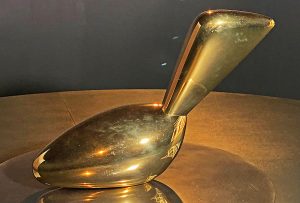
„Leda“, 1926, „Brancusi“, Neue Nationalgalerie, Foto: Holger Jacobs
Dabei konzentrierte er sich auf für ihn besonders wichtige Motive, die er immer wieder neu auflegte, wie z.B. das Portrait.
Allein vom Kopf seiner Geliebten MARGIT POGANY gibt es vier verschiedene Variationen aus unterschiedlichen Materialien.
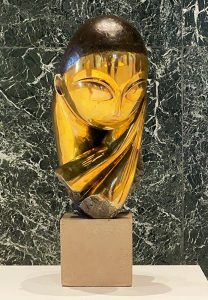
Mlle Pogany I, 1913, „Brancusi“, Neue Nationalgalerie, Foto: Holger Jacobs
Das Motiv der „Muse“, ein liegender Kopf, produzierte er noch häufiger, wobei sich die Reduktion auf nur noch wenige Einkerbungen immer weiter verstärkte.

Sleeping Muse“, 1910, „Brancusi“, Neue Nationalgalerie, Foto: Holger Jacobs
Eine weitere Neuerung war die Herstellung einer Skulptur ohne die vorherige Anfertigung eines Models, von dem man anschließend die eigentliche Skulptur in einem Reproduktionsverfahren anfertigen lässt.
BRANCUSI arbeitete von vorne herein mit dem Endmaterial, was man auch als „taílle direct“ oder auf Englisch als „direct curving“ bezeichnet.
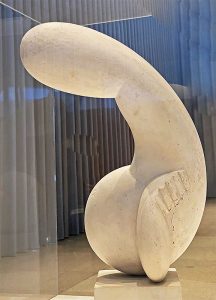
„Princess X“, (phallus), 1915, plaster, „Brancusi“, Neue Nationalgalerie, Foto: Holger Jacobs
Der radikale Weg zur Abstraktion war natürlich die eigentliche Sensation, denn in der Malerei war man noch nicht soweit.
In Frankreich gab es zwar schon den Kubismus von BRAQUE und PICASSO, sowie den FAUVISMUS von HENRI MATISSE und ANDRÈ DERAIN.
Auch in Deutschland entwickelte sich zu dieser Zeit der Expressionismus mit den BRÜCKE-Malern.
Aber die Gegenstände waren immer noch als solche zu erkennen.
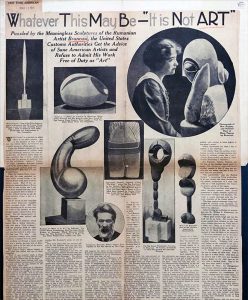
„Brancusi“, Neue Nationalgalerie, Foto: Holger Jacobs
Doch die völlige Abstraktion mit der Reduktion auf nur noch ein paar Linien und Strichen kam erst ab Mitte des 20. Jahrhunderts mit JACKSON POLLOCK, MARK ROTHKO, CY TWOMBLY, BARNETT NEWMAN, JUAN MIRO, RUPRECHT GEIGER, LUCIO FONTANA, sowie den Bildhauern HENRY MOORE, RICHARD SERRA oder FRANK STELLA.
CONSTANTIN BRANCUSI war hier der Vorreiter dieser Entwicklung.
Ausstellung „Brancusi“
Nach dem Tod BRANCUSIS 1957 ging von seinem Nachlass der Inhalt seines Ateliers an den französischen Staat, bzw. an das Musée National d‘ Art Moderne von Paris.

Atelier Brancusi, „Brancusi“, Neue Nationalgalerie, Foto: Holger Jacobs
Beim Bau des CENTRE POMPIDOU Anfang der 70er Jahre wurde entschieden, dass auf dem Vorplatz des Museums das Atelier BRANCUSIS nachgebaut werden sollte. Architekt RENZO PIANO fertigte eine Rekonstruktion an.
Seither ist es dort der Öffentlichkeit zugänglich.
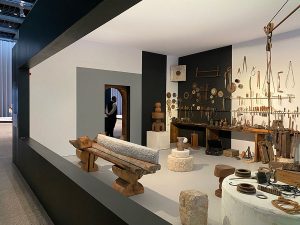
Atelier Brancusi reconstruction, „Brancusi“, Neue Nationalgalerie, Foto: Holger Jacobs
Als im September 2025 das CENTRE POMPIDOU für eine notwendige Renovierung für fünf Jahre geschlossen wurde, fragte die Neue Nationalgalerie unter der Leitung von Direktor KLAUS BIESENBACH bei den zuständigen Behörden in Frankreich an, ob der Inhalt dieses Ateliers zusammen mit vielen weiteren Werken von BRANCUSI an Berlin ausgeliehen werden könnte (ähnlich wie vor 20 Jahren die berühmte Ausstellung „Das Moma in Berlin“ in der Neuen Nationalgalerie mit Werken vom Museum of Modern Art in New York, während dieses umgebaut wurde).
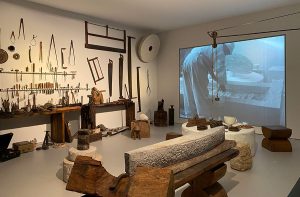
Atelier Brancusi reconstruction, „Brancusi“, Neue Nationalgalerie, Foto: Holger Jacobs
Als die Zusage kam, wurden noch mehr Arbeiten von BRANCUSI aus der ganzen Welt zusammengetragen, um eine große Ausstellung mit 150 Skulpturen aus all seinen Schaffensperioden präsentieren zu können.
Dabei zeigt sich die weitläufige Räumlichkeit der großen Glashalle der Neuen Nationalgalerie als ideal.
Jede Arbeit hat viel Platz zu wirken und kann von allen Seiten betrachtet werden.
Auch die hochragenden, marmornen Säulen der Halle tragen auf Grund ihres Materials zur Wirkung der Kunstwerke bei.
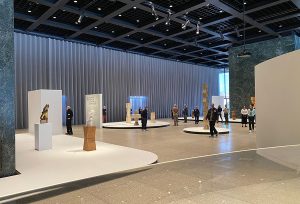
„Brancusi“, Neue Nationalgalerie, Foto: Holger Jacobs
Fazit: Für mich die beste Ausstellung in der Neuen Nationalgalerie seit langem.
„Brancusi“
20.3. – 9.8.2026
Neue Nationalgalerie
Potsdamer Strasse 50, 10785 Berlin
Di – So 10 – 18 Uhr, Do – 20 Uhr, Mo geschlossen
Bilderserie mit 13 Fotos von Brancusis Skulpturen:
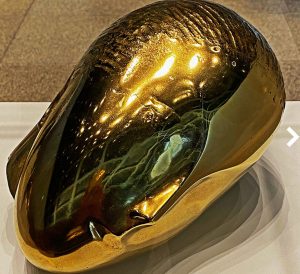
„Sleeping Muse“, 1910, „Brancusi“, Neue Nationalgalerie, ph: Holger Jacobs
English Text
BRANCUSI Exhibition at the Neue Nationalgalerie Berlin
By Holger Jacobs
February 11, 2026
Rating: 🙂 🙂 🙂 🙂 🙂 (five of five)
The Extraordinary Sculptures of Constantin Brancusi
One of the most important sculptors of the 20th century is little known in Germany.
The reasons for this can only be guessed at. Perhaps it was due to the political turmoil in Europe at the beginning to middle of the 20th century, perhaps it was due to the popularity of our own sculptors, such as Wilhelm Lehmbruck or Georg Kolbe.
Or perhaps it was also due to the ban on modern art in the Third Reich.
Or perhaps the interest in sculpture is simply less pronounced here in Germany than, for example, in France.
Whatever the reasons, the name BRANCUSI is little known here – now there is an opportunity to rectify this.
„Brancusi“, Neue Nationalgalerie, Foto: Holger Jacobs
Through a major retrospective at the Neue Nationalgalerie with 150 works by this exceptional artist, who profoundly shaped the history of sculpture in the 20th century.
„Brancusi“, Neue Nationalgalerie, Foto: Holger Jacobs
Constantin Brancusi
Born in Romania in 1876, BRANCUSI arrived in Paris in 1904 after many travels that took him to Vienna, Budapest, Munich, and Basel, among other places.
He was drawn by the many tales of the rich artistic scene in the French capital.
At the turn of the century, Paris was the center of the European art scene.
Anyone who wanted to succeed as an artist had to go to the city of love and excess.
This was the Belle Époque.
Constantin Brancusi, „Brancusi“, Neue Nationalgalerie, Foto: Holger Jacobs
From visual and performing arts to music, theater, opera, ballet, and sculpture—everything and everyone met in Paris, forming a melting pot of creativity.
Brancusi initially studied at the renowned École Nationale Supérieure des Beaux-Arts on the Left Bank of the Seine and was able to exhibit two works at the Salon d’Automne in 1906, where he met Auguste Rodin.
In 1907, BRANCUSI completed a one-month apprenticeship with Rodin and subsequently established his own studio.
„Brancusi“, Neue Nationalgalerie, Foto: Holger Jacobs
Through Romanian friends, he received his first commissions and set up his studio at 54, rue du Montparnasse, in the immediate vicinity of Edward Steichen.
During this time, he also formed friendships with other artists, such as Henri Matisse, Marcel Duchamp, Man Ray, and Amadeo Modigliani.
Amadeo Modigliani „Kopf“, 1913, „Brancusi“, Neue Nationalgalerie, Foto: Holger Jacobs
The friendship with Modigliani, in particular, had a profound influence on both artists.
BRANCUS’s works became increasingly narrow and elongated, as did Modigliani’s portraits in painting and sculpture.
„Brancusi“, Neue Nationalgalerie, Foto: Holger Jacobs
Also important during this period was his connection with the art collector Paul Alexander, who became a patron of BRANCUSI.
Armory Show, New York, 1913, „Brancusi“, Neue Nationalgalerie, Foto: Holger Jacobs
From 1908 onward, BRANCUSI developed a new form of sculpture.
No more realistic representations, as he had experienced under Rodin.
Instead, he abstracted reality, which in the following years evolved into sculptures consisting only of lines (Bird in Space, 1941), convoluted objects (The Rooster, 1935), or amorphous forms (Seal).
„Leda“, 1926, „Brancusi“, Neue Nationalgalerie, Foto: Holger Jacobs
He concentrated on motifs that were particularly important to him, which he repeatedly revisited, such as the portrait.
For example, there are four different variations of the head of his lover, Margit Pogany, made from various materials.
Mlle Pogany I, 1913, „Brancusi“, Neue Nationalgalerie, Foto: Holger Jacobs
He produced the motif of the „Muse,“ a reclining head, even more frequently, with the reduction to just a few indentations becoming increasingly pronounced.
Sleeping Muse“, 1910, „Brancusi“, Neue Nationalgalerie, Foto: Holger Jacobs
Another innovation was the creation of a sculpture without first making a model from which the actual sculpture would then be reproduced.
BRANCUSI worked with the material from the outset, a technique also known as „direct curving.“
„Princess X“, (phallus), 1915, plaster, „Brancusi“, Neue Nationalgalerie, Foto: Holger Jacobs
The radical path to abstraction was, of course, the real sensation, as painting hadn’t yet reached that point.
In France, there was already Cubism with Braque and Picasso, as well as Fauvism with Henri Matisse and André Derain.
Expressionism was also developing in Germany at this time with the Brücke painters.
But the objects were still recognizable as such.
However, complete abstraction, with the reduction to just a few lines and strokes, only emerged in the mid-20th century with Jackson Pollock, Mark Rothko, Cy Twombly, Barnett Newman, Juan Miró, Ruprecht Geiger, Lucio Fontana, and the sculptors Henry Moore, Richard Serra, and Frank Stella.
CONSTANTIN BRANCUSI was the pioneer of this development.
„What ever this may be…“, „Brancusi“, Neue Nationalgalerie, Foto: Holger Jacobs
Exhibition “Brancusi”
After BRANCUSI’s death in 1957, the contents of his studio were given to the French state, specifically to the Musée National d’Art Moderne in Paris.
Atelier Brancusi, „Brancusi“, Neue Nationalgalerie, Foto: Holger Jacobs
During the construction of the Centre Pompidou in the early 1970s, it was decided that BRANCUSI’s studio should be reconstructed in the museum’s forecourt.
The Centre Pompidou architect Renzo Piano created a reconstruction.
Since then, it has been open to the public.
Atelier Brancusi reconstruction, „Brancusi“, Neue Nationalgalerie, Foto: Holger Jacobs
When the Centre Pompidou closed for a necessary five-year renovation in September 2025, the Neue Nationalgalerie, under the direction of his director Klaus Biesenbach, inquired with the relevant authorities in France whether this studio, along with many other works by Brancusi, could be loaned to Berlin (similar to the famous exhibition “The MoMA in Berlin” at the Neue Nationalgalerie 20 years earlier, which featured works from the Museum of Modern Art in New York while it was undergoing renovations).
Atelier Brancusi reconstruction, „Brancusi“, Neue Nationalgalerie, Foto: Holger Jacobs
When the confirmation came through, even more works by BRANCUSI were gathered from around the world to present a major exhibition of 150 sculptures from all periods of his career.
The spaciousness of the large glass hall at the Neue Nationalgalerie proved ideal.
Each work has enough room to make its impact and can be viewed from all sides.
The hall’s soaring marble columns also contribute to the effect of the artworks due to their material.
„Brancusi“, Neue Nationalgalerie, Foto: Holger Jacobs
In conclusion: For me, the best exhibition at the Neue Nationalgalerie in a long time.
“Brancusi”
March 20 – August 9, 2026
Neue Nationalgalerie
Potsdamer Strasse 50, 10785 Berlin
Tue – Sun 10 am – 6 pm, Thu – 8 pm, Mon closed
Image series with 13 photos of Brancusi’s sculptures:
„Sleeping Muse“, 1910, „Brancusi“, Neue Nationalgalerie, ph: Holger Jacobs

Author: Holger Jacobs
Founder & Editorial Director of kultur24.berlin ug.
Founder & Editorial Director of kultur24 TV on Youtube.
Former correspondent for fashion in Paris.
Photographer, writer and videographer.