


Porträts – Von Botticelli bis Lempicka in der Gemäldegalerie Berlin
Von Holger Jacobs

18.10.2026
Wertung: 🙂 🙂 🙂 (drei von fünf)
Die Darstellung des menschlichen Gesichts über sechs Jahrhunderte
Als ich im Jahre 2001 das neu eröffnete TATE MODERN Museum in London besuchte, war die permanente Ausstellung in vier Themen-Bereiche aufgeteilt:
Landschaft, Stillleben, Portrait und Akt.
Es sind diese vier Themen, die letztlich auch die meisten Themen in der Bildenden Kunst darstellen.
Und das Portrait (franz. Schreibweise mit „ai“) gehört sicherlich zu den wichtigsten.
Die Bedeutung des Portraits eines Menschen hat heute mit der Kamerafunktion im Smartphone, welches wir alle ständig mit uns tragen, eher noch zugenommen.
Selfies: Wir fotografieren uns selbst an wechselnden Orten, meist um zu zeigen, wie aufregend unser Leben ist.
Beispiel: Selfie mit Leonardo DiCaprio bei der Berlinale 2010, nicht in der Ausstellung:
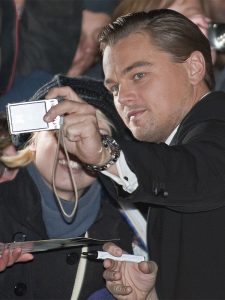
Selfie mit Leonardo DiCaprio, 2010 -CC-Wikimedia Commons
Ein Portrait ist die Wiedergabe eines Gesichts, welches für uns Menschen das wichtigste Erkennungsmerkmal ist.
Es ist wie ein Fingerabdruck.
Zusätzlich gibt das Gesicht durch seinen wechselnden Ausdruck unsere Gemütslage und Stimmung wieder, die wir so mit anderen teilen können.
Ausstellung „Portraits – Überraschende Begegnungen von Botticelli bis Lempicka“
Die Gemäldegalerie in Berlin kennt die Bedeutung des Portraits in der Kunstgeschichte und hatte wohl deshalb die Idee, Arbeiten zu diesem Thema über die Jahrhunderte hinweg gegenüber zu stellen, um zu zeigen, wie sich der Stil der Darstellung verändert hat oder auch nicht.
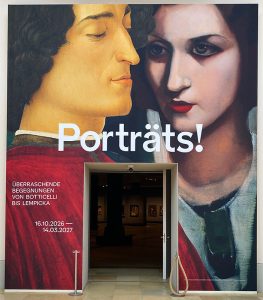
Eingang zu „Portraits“ in der Gemäldegalerie, Foto: Holger Jacobs
Die Ausstellung mit 90 Gemälden ist untergliedert in vier Bereiche:
– Portraits diesseits und jenseits der Alpen
– Selbstdarstellung der Eliten
– Familie
– Bildnisse von Künstlern
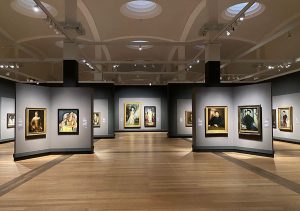
Ausstellung „Portraits“, Gemäldegalerie Berlin, Foto: Holger Jacobs
Beim Rundgang durch diese temporäre Ausstellung stellen wir fest, dass sich die Meister auf drei Formen der Darstellung konzentrierten:
Ansicht von der Seite, die Dreiviertel-Ansicht und Frontalansicht.
Mit dem Zusatz, dass es bei den beiden Letztgenannten noch die Möglichkeit des direkten Augenkontaktes gibt, besonders wirkungsvoll bei der Frontalansicht.

Anders Zorn, 1900, „Portraits“, courtesy Alte Nationalgalerie, Foto: Holger Jacobs
Als Fotograf hatte ich in meiner beruflichen Laufbahn natürlich ständig mit dem Thema Portrait zu tun.
Als Beispiel mein Porträtfoto der Schauspielerin ANNA-MARIA MÜHE, nicht in der Ausstellung:
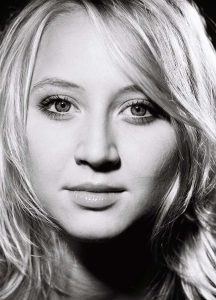
Anna-Maria Mühe, 2008, © Holger Jacobs
Und bei dem berühmten Fotografen PETER LINDBERGH erschienen selbst Modefotos wie Portraits von jungen Frauen.
Peter Lindbergh, „Supermodels“, British Vogue 1990, nicht in der Ausstellung:
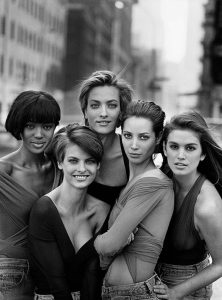
Peter Lindbergh, British Vogue, 1990 © Peter Lindbergh
Bei den Portraits in der Gemäldegalerie sehen wir sowohl inszenierte Darstellungen mit viel Kopfschmuck, Kleidung und Hintergrund.
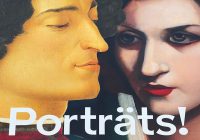
Aber auch stark reduzierte Portraits, bei denen (fast) nur das Gesicht zu sehen ist – wie bei SANDRO BOTICELLI und TAMARA LEMPICKA, die deshalb auch gleich nebeneinander hängen.
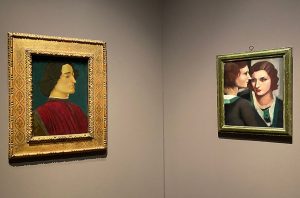
Botticelli (links), Lempicka (rechts), „Portraits“, Gemäldegalerie, Foto: Holger Jacobs
Überhaupt war es das besondere Anliegen der beiden Kuratoren, SVEN JAKSTAT und STEPHAN KEMPERDICK, immer zwei Gemälde nebeneinander zu zeigen, die aus Gründen der Darstellung Ähnlichkeiten aufweisen.
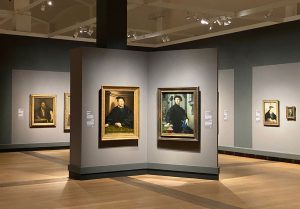
„Portraits“, Gemäldegalerie, Foto: Holger Jacobs
Was ich vermisst habe waren mehr Portraits aus dem 19. und 20. Jahrhundert.
Außer einem LOVIS CORINTH aus dem Jahr 1909, einem Portrait von EUGEN SPIRO von 1929 und einem WILLI DÖRING von 1901 war nicht viel aus der neueren Zeit zu sehen.
Es ist sicher dem Umstand geschuldet, dass die Gemäldegalerie nur Bilder bis zum 18. Jahrhundert in der Sammlung hat.
Alle jüngeren Arbeiten müssen von anderen Museen ausgeliehen werden.
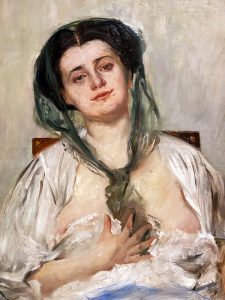
Lovis Corinth, 1909, „Portraits“, courtesy Alte Nationalgalerie, Foto: Holger Jacobs
Ganz am Ende noch ein Gemälde von Picasso („Frau mit Hut“) von 1938, welches dank seiner außergewöhnlichen Portrait-Darstellung mit Kopf aus zwei Perspektiven etwas aus dem Rahmen fiel.
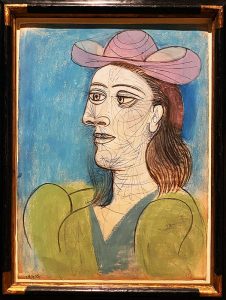
Picasso „Frau mit Hut“, 1938, courtesy Museum Berggruen, Foto: Holger Jacobs
Trotzdem finde ich die Ausstellung interessant.
Vielleicht wird es einmal eine wirklich große Show in Berlin geben mit den unzähligen Aspekten des Portraits, welche sich gerade in unserer digitalen Zeit vervielfältigt haben.
Nach neusten Schätzungen werden auf der Welt ca. 5,3 Milliarden Fotos gemacht – pro Tag!
Und die Hälfte davon sind sicher Portraits oder Selfies.
„Portraits! Überraschende Begegnungen von Botticelli bis Lempicka“
16. Okt. 2026 – 14. März 2027
Gemäldegalerie Berlin
Matthäikirchplatz, 10785 Berlin
Di – So 10 – 18 Uhr
Bilderserie mit 16 Gemälden der Ausstellung:
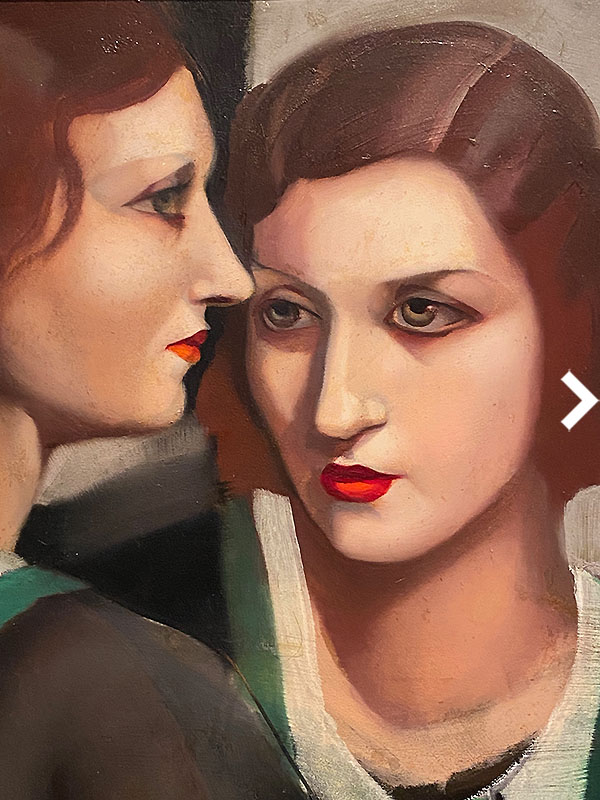
Tamara de Lempicka, 1931, Sammlung Pietsch, Foto: Holger Jacobs
English
Portraits – From Botticelli to Lempicka at the Gemäldegalerie Berlin
By Holger Jacobs
October 18, 2026
Rating: 🙂 🙂 🙂 (three of five)
The Depiction of the Human Face Across Six Centuries
When I visited the newly opened Tate Modern museum in London in 2001, its permanent exhibition was divided into four thematic areas:
Landscape, Still Life, Portrait, and Nude.
These four themes essentially encompass the majority of subjects found in the visual arts.
And the portrait is, without a doubt, one of the most significant.
The importance of a human portrait has arguably grown even further today, thanks to the camera function on the smartphones we all carry with us at all times.
Selfie: We photograph ourselves and others in various locations—often exciting is our life.
Example: Selfie with Leonardo DiCaprio at the 2010 Berlinale, not included in the exhibition:
Selfie mit Leonardo DiCaprio, 2010 -CC-Wikimedia Commons
A portrait is a rendering of a face, which serves as the primary identifying feature for us as human beings.
It is much like a fingerprint.
Furthermore, through its ever-changing expressions, the face reveals our state of mind and mood, allowing us to share these inner experiences with others.
Exhibition: „Portraits – Surprising Encounters from Botticelli to Lempicka“
The Gemäldegalerie in Berlin recognizes the significance of the portrait within art history.
It was likely this awareness that inspired the idea to juxtapose works on this theme from across the centuries—revealing how the style of representation has evolved, or, in some cases, remained the same.
Eingang zu „Portraits“ in der Gemäldegalerie, Foto: Holger Jacobs
The exhibition, featuring 90 paintings, is divided into four sections:
– Portraits from both sides of the Alps
– Self-representation of the elites
– Family
– Portraits of artists
Ausstellung „Portraits“, Gemäldegalerie Berlin, Foto: Holger Jacobs
As I walk through this temporary exhibition, I observe that the masters focused on three modes of depiction:
the profile view, the three-quarter view, and the frontal-view.
It should be added that the three-quarter view and the frontal view allow for the possibility of direct eye contact—an effect that is particularly striking in the frontal view.
Anders Zorn, 1900, „Portraits“, courtesy Alte Nationalgalerie, Foto: Holger Jacobs
As a photographer, I have, of course, dealt with the subject of portraiture throughout my professional career.
Example: photo of actress ANNA-MARIA MÜHE „words“, 2008, not in the exhibition:
Anna-Maria Mühe, 2008, © Holger Jacobs
In the work of the renowned photographer PETER LINDBERGH, even fashion photographs appeared as portraits of individuals.
Photo by Lindbergh,“Supermodels“, British Vogue Jan. 1990, not in the exhibition:
Peter Lindbergh, British Vogue, 1990 © Peter Lindbergh
Some of the portraits in this gallery include highly staged compositions, rich in elaborate headwear, clothing, and background detail.
Others are starkly minimalist, showing (almost) nothing but the face—as seen in the works of SANDRO BOTTICELLI and TAMARA DE LEMPICKA, which are, fittingly, hung side by side.
In fact, it was a key objective of the two curators, Sven Jakstat and Stephan Kemperdick, to pair paintings that share formal similarities in their mode of representation.
Botticelli (links), Lempicka (rechts), „Portraits“, Gemäldegalerie, Foto: Holger Jacobs
What I found missing were portraits from the 19th and 20th centuries.
Aside from a work by Lovis Corinth (1909), a portrait by Eugen Spiro (1929), and one by Willi Döring (1901), there was not much on display from this more recent period.
This is surely due to the fact that the Gemäldegalerie’s collection only includes paintings up to the 18th century. Any more recent paintings must be borrowed from other museums.
Lovis Corinth, 1909, „Portraits“, courtesy Alte Nationalgalerie, Foto: Holger Jacobs
Right at the end, there is a painting by PABLO PICASSO, „Woman with a Hat“ (1938), which stands out from the rest due to its unusual approach to portraiture, depicting the subject from two perspectives.
Picasso „Frau mit Hut“, 1938, courtesy Museum Berggruen, Foto: Holger Jacobs
Nevertheless, I believe the exhibition is well worth seeing.
Perhaps one day there will be a truly major exhibition in Berlin exploring the countless facets of the portrait—a genre that has only multiplied in our digital age.
According to recent estimates, approximately 5.3 billion photographs are taken worldwide—every single day!
And surely, half of those are portraits or selfies!
„Portraits! Surprising Encounters from Botticelli to Lempicka“
Oct 16, 2026 – Mar 14, 2027
Gemäldegalerie Berlin
Matthäikirchplatz, 10785 Berlin
Tue – Sun, 10 a.m. – 6 p.m.
Picture series with 16 paintings from the exhibition „Portraits“:
Tamara de Lempicka, 1931, Sammlung Pietsch, Foto: Holger Jacobs

Author: Holger Jacobs
Founder & Editorial Director of kultur24.berlin ug.
Founder & Editorial Director of kultur24 TV on Youtube.
Former correspondent for fashion in Paris.
Photographer, writer and videographer.