

Review Berlin Fashion Week SS 2027
Von Holger Jacobs

10.07.2026
for english version click here
Die Berliner Modewoche wird immer größer – und eleganter
Während in den letzten Jahren jede Neuauflage der BERLIN FASHION WEEK von mir mit einiger Skepsis begrüßt wurde, muss ich dieses Mal zugeben, dass die BFW einen Sprung nach vorne gemacht hat.
Mit 52 Runway Shows und 62 Side Events war die jetzige BERLIN FASHION WEEK die Größte seit ihrem Beginn 2007.
Selbst zur letzten Ausgabe, keine 6 Monate her, gab es eine Steigerung:
Im Januar 2026 waren es nur 42 Shows und 52 Events.
Bundeskanzleramt
Und es gab sogar einen Empfang bei Bundeskanzler Friedrich Merz mit Kulturstaatsminister WOLFRAM WEIMER und BFC-Vorstandsvorsitzende CHRISTIANE ARP im Bundeskanzleramt.
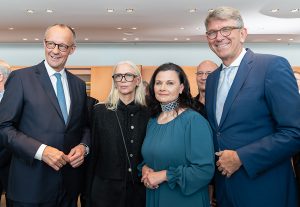
Friedrich Merz, Christiane Arp, Gitta Connemann, Wolfram Weimer, ph: Alicja Bokina
Größe bedeutet auch Risiko
Doch die Größe birgt auch gewisse Risiken.
Denn fast jeder Designer suchte sich seine eigene Runway Location aus, was dazu führte, dass der interessierte Besucher von einem Ende der Stadt zur anderen rasen musste, wollte man keine Show versäumen.
Selbst der eigene BFW-Fahrdienst war da manches Mal überfordert.
Denn nicht jeder Designer war diesem System angeschlossen.
Allein die 19 Brands der wichtigsten Kategorie „Berlin Contemporary“ zeigten ihre Shows an 19 verschiedenen Orten!
Auch die mühselige Akkreditierung für Journalisten und Fachpublikum sich für jede einzelne Show extra anmelden zu müssen wird so manchen Besucher abgeschreckt haben, besonders die, die aus dem Ausland anreisen.
ICC

ICC (Inernational Congress Centrum), ph: Holger Jacobs
Nur diese vier Designer UNVAIN, MARKE, ORANGE CULTURE und BUZIGAHALL zeigten ihre Kollektionen an einem gemeinsamen Ort, durchgeführt durch die Agentur NOWADAYS mit ihrem Format NEWEST:
Im ICC (International Congress Centrum), was für mich von der Örtlichkeit eines der Highlights bedeutete.
RAUM.Berlin im John Jahr Haus
Ein weiteres Highlight, was die Örtlichkeit anbelangte, war der Showroom in der 16. Etage des neuen JOHN JAHR HAUSES an der Kurfürstenstraße 25 mit Blick über die ganze Stadt.
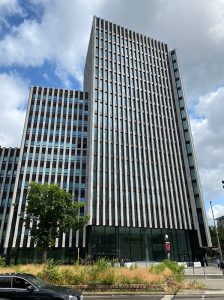
John Jahr Haus, Berlin, ph: Holger Jacobs
Die dort ausgeführten Präsentationen mit einer Art Performance der Models hat mir sehr gut gefallen.
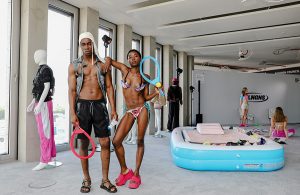
PLNGN, John Jahr Haus, ph: Celine Witon
Young Designers
Und warum gibt es allein für den Nachwuchs innerhalb der Branche drei verschiedene Formate an fünf verschiedenen Orten?
Berlin Curated, NEO.Fashion und PLATTE presents?
Auf allen drei wurden Modelle von Modeschülern gezeigt.
Hier hätte ein Ort für alle Formate die Arbeit von Journalisten und Einkäufern sehr erleichtert.
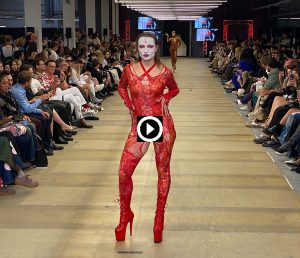
NEO-Fashion, ph: Holger Jacobs
Diese vielen Shows an kilometerweit verstreuten Orten führt leider dazu, dass selbst der engagierte Besucher nur einen Bruchteil aller Kollektionen zu Gesicht bekommt.
Und das ist schade!
Zu viele Runway Locations
Ich möchte an dieser Stelle daran erinnern, wie die Pariser Modeindustrie Anfang der 1980er Jahre in großen Schwierigkeiten steckte und drohte von Mailand überholt zu werden.
Der im Jahre 1981 gewählte französische Präsident FRANCOIS MITTERAND, ein großer Liebhaber der Künste, nahm daraufhin das Problem persönlich in die Hand und ließ im Hof des Louvre ein großes Zelt aufbauen, worin fast alle Modenschauen nacheinander stattfinden konnten.
Parallel dazu ordnete MITTERAND im Projekt „Le Grand Louvre“ die Neustrukturierung des gesamten Museums an , wozu nicht nur ein neuer Eingang (Pei-Pyramide) gebaut wurde, sondern auch eigens für Modenschauen gebaute Veranstaltungssäle unter dem Louvre entstanden, in denen bis heute die meisten Shows stattfinden.

Museum LOUVRE, Paris -CC-Wikimedia Commons
Die neue Eleganz
Mir fiel auf, dass die jetzt in Berlin gezeigte Mode deutlich eleganter und damit attraktiver geworden ist und sich endlich von der bisher vorherrschenden reinen Club- und Streetwear verabschiedet hat.
Wie z.B. bei der Show von BUZIGHILL im ICC , wo die Models keine Sneakers mehr trugen, sondern glänzende Lackschuhe!

BUZIGAHILL, ICC, ph: Ken Dumevi
Liegt das vielleicht daran, dass in Berlin immer mehr Clubs zugemacht haben?
Oder liegt es daran, dass jeder Hype auch mal ein Ende hat?
Und kommt jetzt die Ära der neuen Eleganz?
Strick und Transparenz
Ein weiterer Trend, der zu beobachten war, ist die Verwendung von gestrickten oder gehäkelten Stoffen, die mehr oder weniger Transparenz bieten und damit die Silhouette des Körpers betonen.
Zu sehen bei:
LOU DE BÈTOLY,
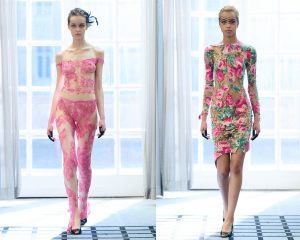
LOU DE BETOLY, ph: James Cochrane
bei REBEKKA RUETZ,

REBEKKA RUETZ, ph: Marcus Hartelt
bei RITUAL UNIONS,
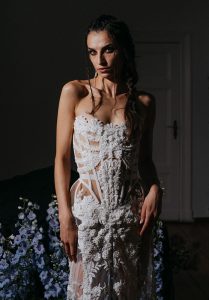
RITUAL UNIONS. ph: Vanessa Wunsch
bei KASIA KUCHARSKA ,
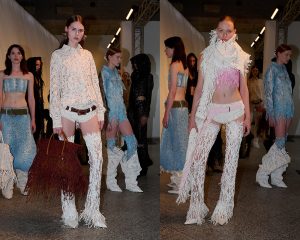
KASIA KUCHARSKA, ph: James Cochrane
bei LAURA GERTE
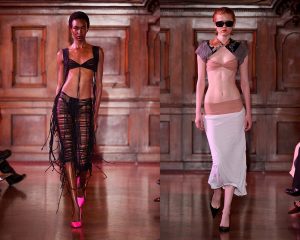
LAURA GERTE, ph: James Cochrane
und bei UNVAIN
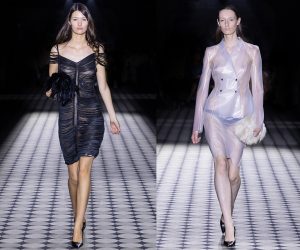
UNVAIN, ICC, ph: Andreas Hofrichter
Oder zarter, transparenter Stoff für den ganzen Körper, wie bei MALAIKARAISS.
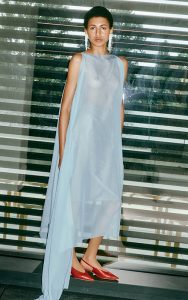
MALAIKARAISS, ph: Marc Krause
Und wie bei NAOMI TARAZI in der 16. Etage des John Jahr Hauses beim Format RAUM.Berlin.
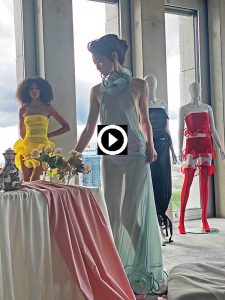
NAOMI TARAZI, John Jahr Haus, Video: Holger Jacobs
Sehr sexy!
Der Berliner Salon
Auch hier gab es eine neue Location:
Das Schloss Charlottenburg, genauer gesagt die Orangerie des Schlosses.
Deren langgezogenen Räumlichkeiten werden häufig für Veranstaltungen gebucht.

Orangerie, Schloss Charlottenburg, ph: Holger Jacobs
Auf dem diesjährigem BERLINER SALON waren 63 Designer präsent, kuratiert von CHRISTIAN ARP.
Neben den Modellen auf Schaufensterpuppen war es auch ein großes Treffen der Berliner Modebranche und vieler Freunde der Berliner Kunstszene.
Leider war der Besuch des BERLINER SALONS nur auf persönliche Einladung möglich und damit ohne Chance für die Öffentlichkeit sich die Arbeiten anzuschauen, so wie früher. Hoffentlich klappt das beim nächsten Mal wieder.
Fazit: Insgesamt eine gute BERLIN FASHION WEEK!

MARIA MELZER, Der Berliner Salon, ph: Holger Jacobs
English
Berlin Fashion Week SS 2027 Review
By Holger Jacobs
July 1o, 2026
Berlin Fashion Week is growing—and becoming more elegant.
While I had greeted previous editions of Berlin Fashion Week with some skepticism in recent years, I must admit that BFW has taken a leap forward this time.
With 52 runway shows and 62 side events, this edition of Berlin Fashion Week was the largest since its inception in 2007.
There was an increase even compared to the last edition, held less than six months ago:
In January 2026, there were only 42 shows and 52 events.
Federal Chancellery
There was even a reception at the Federal Chancellery hosted by Federal Chancellor Friedrich Merz, attended by Minister of State for Culture Wolfram Weimer and BFC Chairwoman Christiane Arp.
Friedrich Merz, Christiane Arp, Gitta Connemann, Wolfram Weimer, ph: Alicja Bokina
Size as a risk
However, this scale also entails certain risks.
Since almost every designer chose their own venue, interested visitors had to run from one end of the city to the other if they didn’t want to miss a show.
Even the dedicated BFW shuttle service was sometimes overwhelmed by the demand.
After all, not every designer was part of this system.
The 19 brands in the key „Berlin Contemporary“ category alone held their shows at 19 different locations!
The exhausting accreditation process—journalists and industry professionals had to register separately for every single show—likely deterred many visitors, especially those traveling from abroad.
ICC
Only these four designers—UNVAIN, MARKE, ORANGE CULTURE, and BUZIGHALL—showed their collections at a shared venue, organized by the agency NOWADAYS as part of its „NEWEST“ format:
The ICC (International Congress Center), which, in terms of location, was one of the highlights for me.
ICC (Inernational Congress Centrum), ph: Holger Jacobs
RAUM.Berlin at John Jahr Haus
Another highlight regarding the venue was the showroom on the 16th floor of the new JOHN JAHR HAUS at Kurfürstenstraße 25, which offered a view across the entire city.
John Jahr Haus, Berlin, ph: Holger Jacobs
I also really enjoyed the presentations held there, which featured a kind of performance by the models.
PLNGN, John Jahr Haus, ph: Celine Witon
Young Designers
And why are there three different formats at five different locations just for emerging talent within the industry—Berlin Curated, NEO.Fashion, and PLATTE presents?
Designs by fashion students were showcased at all three.
In this case, a single venue for all these formats would have made life much easier for journalists and buyers.
Unfortunately, having so many shows spread across locations miles apart means that even a dedicated visitor gets to see only a fraction of the collections.
And that is a pity!
NEO-Fashion, Video: Holger Jacobs
To many runway locations
At this point, I would like to remember how the Parisian fashion industry was in deep trouble in the early 1980s, facing the threat of being overtaken by Milan.
French President François Mitterrand—elected in 1981 and a great lover of the arts—personally took charge of the issue, commissioning the construction of two large tents in the Louvre courtyard where almost all the fashion shows could be held in succession.
At the same time, as part of the „Le Grand Louvre“ project, Mitterrand ordered a restructuring of the entire museum; this involved not only the construction of a new entrance (the Pei Pyramid) but also the creation of event halls beneath the Louvre specifically designed for fashion shows—venues where the majority of shows still take place today.
Museum LOUVRE, Paris -CC-Wikimedia Commons
The New Elegance
I noticed that the fashion currently being shown in Berlin has become significantly more elegant—and thus more attractive—and has finally moved away from the purely club- and streetwear styles that previously dominated the scene.
Take the BUZIGAHILL show at the ICC, for instance, where the models no longer wore sneakers but shiny patent leather shoes!
Could this be because more and more clubs in Berlin have closed down?
Or is it simply that every hype eventually comes to an end?
And are we now entering an era of new elegance?
BUZIGAHILL, ICC, ph: Ken Dumevi
Knitwear and transparency
Another observable trend is the use of knitted or crocheted fabrics that offer varying degrees of transparency, thereby accentuating the body’s silhouette.
This was seen at:
LOU DE BÈTOLY,
LOU DE BETOLY, ph: James Cochrane
REBEKKA RUETZ,
REBEKKA RUETZ, ph: Marcus Hartelt
RITUAL UNIONS
RITUAL UNIONS. ph: Vanessa Wunsch
KASIA KUCHARSKA,
KASIA KUCHARSKA, ph: James Cochrane
LAURA GERTE,
LAURA GERTE, ph: James Cochrane
and UNVAIN.
UNVAIN, at ICC, ph: Andreas Hofrichter
Or delicate, sheer fabric covering the entire body, as seen at MALAIKARAISS.
MALAIKARAISS, ph: Marc Krause
And as shown by NAOMI TARAZI on the 16th floor of the John Jahr Building as part of the RAUM.Berlin showcase.
NAOMI TARAZI, John Jahr Haus, Video: Holger Jacobs
Very sexy!
Der Berliner Salon
There was a new venue here as well: Charlottenburg Palace—or more precisely, the palace’s Orangery.
Its long halls are frequently booked for events.
Orangerie, Schloss Charlottenburg, ph: Holger Jacobs
Sixty-three designers were featured at this year’s BERLINER SALON, curated by Christiane Arp.
Beyond the designs displayed on mannequins, the event served as a major meeting for the Berlin fashion industry and many friends from the city’s art scene.
Unfortunately, attendance was by personal invitation only, meaning the general public had no opportunity to view the work.
Hopefully, that will be possible again next time.
Conclusion: All in all, a great BERLIN FASHION WEEK!
MARIA MELZER, Der Berliner Salon, ph: Holger Jacobs

Author: Holger Jacobs
Founder & Editorial Director of kultur24.berlin ug.
Founder & Editorial Director of kultur24 TV on Youtube.
Former correspondent for fashion in Paris.
Photographer, writer and videographer.